
We don’t have to think deeply about everything. Most of life’s decisions are most efficiently handled by ordinary thinking. Should you go to McDonald’s or Burger King? Should you take this route to the mall or that one?
So, let’s sort out those decisions in which ordinary thinking is adequate, and those that would benefit from thinking better. In order to do so, let’s conceive of a spectrum on which every possible ‘thinking’ situation can be placed. We can then rate each based on the anticipated consequences of the decision.
When we look at the potential consequences of the decision, we can spread them out from one extreme to the other. On the left end of the spectrum are those simple, relatively inconsequential situations, and on the right end are those decisions that are life-altering. 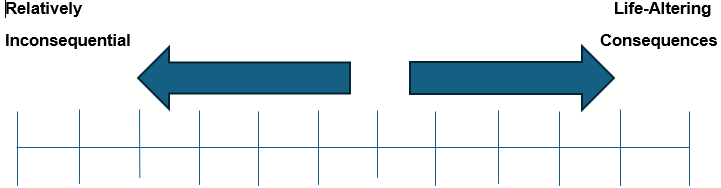
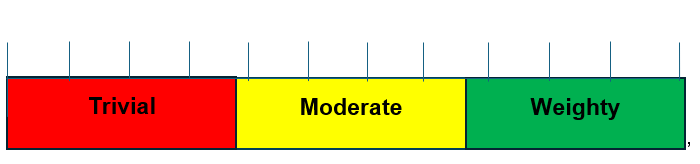
Now, let’s break the spectrum into three classifications. The first, which exists on the far left, we’ll call “simple” or “trivial” situations. Should you see this movie or that one? Should you call your mother today or tomorrow? Trivial situations are easily handled with slow thinking and are not the concern of this manuscript.
Next are moderate situations, which occupy the middle of the spectrum. Moderate decisions are of consequence but aren’t life-altering. Think, for example of having a somber conversation with your teenager, writing a serious email to a colleague, or taking part in a regular team meeting. We label these “opportunities” because they can often be enhanced with Menta-Morphosis tools and tactics, but don’t call for the full force of the Menta-Morphosis system.
Those consequential decisions that call for the full force of the Menta-Morphosis System occupy the space on the far right of the spectrum. These are complex, sophisticated decisions, the consequences of which can impact a person’s life or an organization’s future. Deciding who to hire, buying a home, or deciding which job to take are examples. We label these weighty situations and call them thinking projects. Weighty situations call for the application of the Menta-Morphosis System.
The first challenge, then, is to recognize a moderate or weighty situation,
Trivial situations don’t require any arduous thought and are handled thoughtlessly.
For moderate situations, when we apply some Menta-Morphosis tools and tactics we improve the clarity, the focus and the quality of the result. .
And for weighty situations, by applying the full force of Menta-Morphosis, we create dramatically better results.
Here’s a diagram that illustrates the relationship among the Menta-Morphosis components and the applications for them.
Fast thinking Menta-Morphosis Tools Menta-Morphosis System
No Menta-Morphosis Application and tactics
You may choose an issue that presents itself in your life or job. For example, you may be having trouble with a teenager or need to make a significant decision at work.
Or you may decide to tackle some issue that generations of people have considered important enough to invest serious thinking in better time and energy. Click here to see our list of issues.
Recognizing thinking projects
Here’s how to recognize a weighty decision.
- Is the project complex? In other words, is it composed of a number of sub-tasks? So, if you are a chef, creating a four-course meal is a complex project, and calls for some good thinking before you begin. Boiling an egg isn’t nearly so complex..
- Is this an ongoing or recurring project? In other words, the same project should present itself over and over again. So, if you are a wedding photographer, taking pictures at weddings as a fee paid service is an ongoing project. Creating a process to do it well rises to the level of deserving of good thinking. If, however, you are a guest at the wedding, taking pictures with your cell phone, that probably won’t happen regularly, so it doesn’t require good thinking.
- Are you passionate about this? Your high degree of passion may be a strong enough force to cause you to treat the situation as a thinking project. Is there something about this project that touches your heart and excites you? Are you someone strongly attracted to it?
- Is it significant? While that can mean many things to many people, let’s define it as something that has the potential to impact one or more person’s life in a significant way. The consequences are deep and lasting. Deciding to start a restaurant with your spouse is definitely an important decision, while eating out in that same restaurant is not.
With that, we’re going to introduce an acronym: COPS is how we refer to a weighty situation that calls for better thinking – complex, ongoing, sophisticated and passion-evoking. When we identify a decision or a task as COPS, it’s time to think better about it.
Using this simple acronym will help you recognize the weighty situations in your job and life that call for disciplined thinking and thereby reduce your mistakes and improve your outcomes.
Instead of jumping to a conclusion, take a moment and apply the COPS criteria. If the situation fits, you’ll create far better outcomes by taking the time to think slowly.
****************************************************************************

Access a library of wisdom and knowledge to help you grow your business and accentuate your career. Over 100 short courses designed for B2B salespeople, Sales Leaders and Executives, and Christian businesspeople. Learn more here.

