
There can be no doubt that we are living in unprecedented times. In other posts, I’ve described our present economic and social change as The Age of Turmoil, characterized by rapid and discontinuous change. And now, with the growth of AI, those changes are impacting millions of workers and professionals in ways that were unheard of just a few months ago.
If we are going to survive, much less thrive, in unprecedented times, we’ll need to think deeply about the threats to our livelihood, as well as the opportunities that accompany them.
What should we do?
First, let’s change our mindsets. Rapid change always creates two opposing forces: Danger and Opportunity.
Certainly, rapid change brings danger, as our jobs, our relationships and some of the core beliefs that we have built our lives upon are crumbling. We are in danger of being left without the structure and support we have relied upon to bring us this far, and that is scary.
On the other hand, as things change rapidly, the heat of that change produces opportunities exploding all around us, like popcorn in the microwave.
Our first and most basic response is to manage our mindset and decide to look for the opportunities. For many of us, that requires a conscious, willful decision to look for the opportunities and to pursue those that seem to fit.
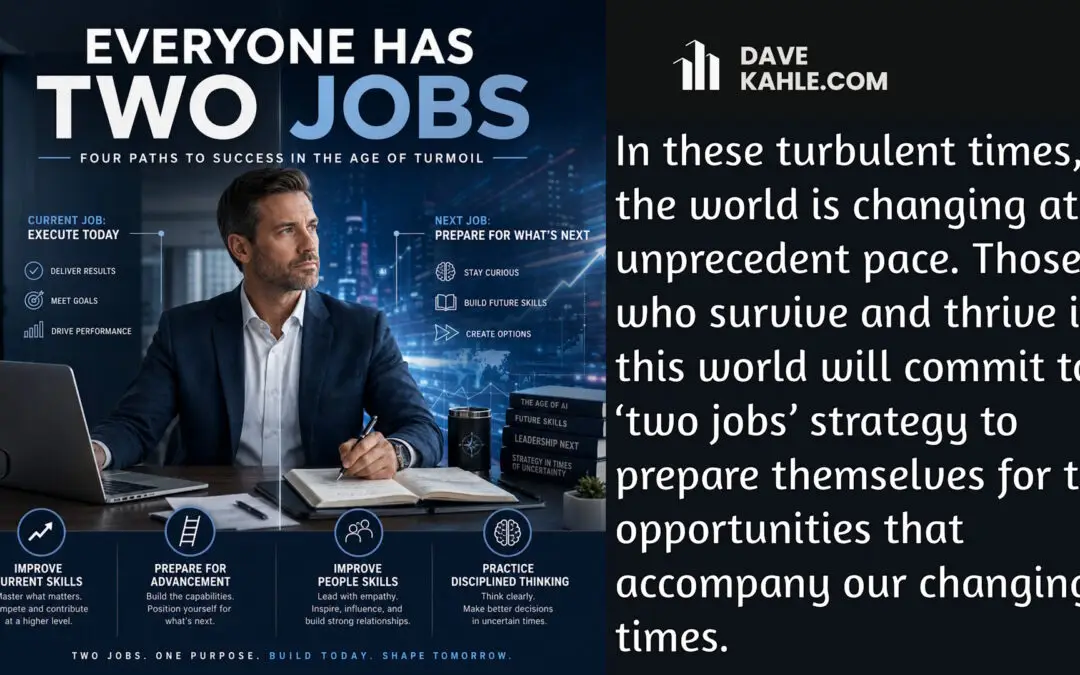
And that brings us to the second survival and thriving strategy for this Age of Turmoil: Decide that you have two jobs:
1. Your job.
2. Preparing yourself for ‘what’s next.’
“Your job” is self-explanatory. You have a responsibility to accomplish, to the best of your ability, the tasks and responsibilities for which you are paid.
It is preparing yourself for ‘what’s next’ that represents a challenge for many of us. Think of it as investing in yourself. Look around you at the opportunities you see, and those that are not yet visible, and prepare yourself to take advantage of those. Here are four specific paths to follow:
1. Be better at what you do. Hone your skills and ‘sharpen the saw.’
If you see the opportunities in your current position, then decide to improve yourself to become even better at what you do. I’ve often thought that improving yourself to excel at your job was both a wise career strategy as well morally right. If you are a salesperson or professional of any type there will be great opportunities for those who become better than the rest and rise to the top.
2. Prepare for advancement.
If you see opportunities for advancement in your current position, prepare now for that. Determine what skills and concepts you will need to become effective in a promotion and build those into your routines. For example, if you aspire to a management position, take some management courses right now. As you invest in yourself and build higher-level skills, you’ll become a more logical candidate for those positions.
In addition to these two job-related areas, begin to hone skills that are universally applicable.
3. Improve your people skills.
There are very few jobs in this world that can’t be enhanced by more refined people skills. No one, as yet, predicts that AI will learn people skills. Those with excellent skills working with people will always have value. Listening, empathizing, encouraging others are skills that lubricate the gears of success in almost every position. And we are never as good as we can be. There is always room for improvement.
4. Learn to think better.
The noted philosopher, Bertrand Russel, once observed,
“Most people would rather die than think. In fact, they do.”
This observation is probably even more true today than in previous generations, as we have software and electronics that think for us. Why bother to learn anything, for example, when you can just look it up on a search engine or AI?
I’m afraid we are witnessing the great dumbing down of humanity. In this tidal wave of lazy thinking there are jetties of opportunity for those who can think with discipline and process. The world will reward the disciplined thinkers of the world with greater responsibility and with the success and fulfillment that accompanies it .(See our Menta-Morphosis ® Thinking System).
But it is one thing to identify a strategy and another to implement it. If you are serious about preparing yourself for ’what’s next,’ consider a five percent investment of time and money into yourself. Five percent of your workweek invested in your second job – preparing yourself for what’s next. And consider a regular investment of money in yourself – five percent of your income into the books, seminars, webinar and classes that will prepare yourself for a more successful future.
To paraphrase a famous coach, ”Lots of people have the will to win, but few have the will to practice.” In this Age of Turmoil, lots of people want to succeed but few have the discipline and commitment to prepare themselves to do so. Now is the time to implement the ‘two jobs’ strategy to ensure your future.
Related Resources

