
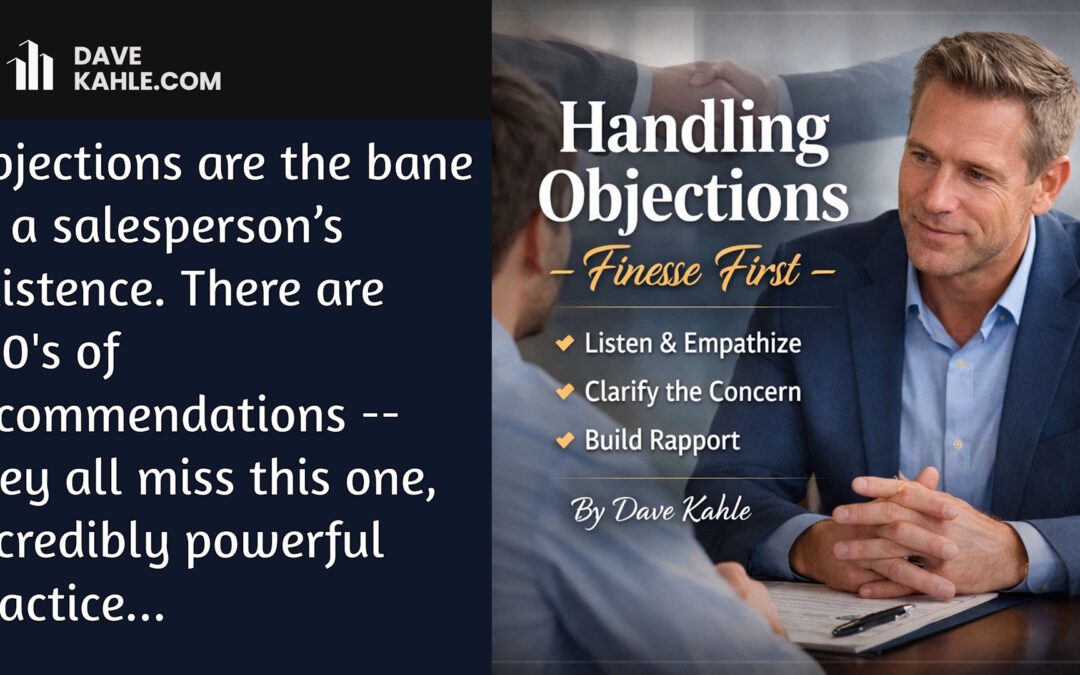
Lurking just over the horizon in
every salesperson’s work is the specter of another objection. Life would be so
much easier if none of our customers had objections to what we are selling.
Objections are everywhere, and on
every salesperson’s mind, and something we deal with every day. Naturally, the world has become full of
advice on how to handle them — Ignore
them, overpower them, etc. While some of these tactics may work in certain
situations, there is a universal need that is rarely mentioned.
Before you begin to deal with the
idea that the customer expressed, first finesse the customer.
Before I describe what that means,
let’s establish some common terminology.
An objection is a stated reason tonot do what you want a customer or
prospect to do. It may be something that he/she doesn’t like about your product
or your offer, like “It costs too much,” or it may be something internal
that has nothing to do with your offer. For example, “The boss is on
vacation, and I can’t do anything until he’s back.”
The knee jerk reaction, and the place
where most advice focuses, is on what to say to dispute the objection. However, everything you say or do can be made
much more effective if you will first, finesse the customer. So, my rule is
“First, finesse the customer
Then, handle the idea expressed.“
Finessing the
customer means to intervene in the conversation in such a way so as to take the
tension out of the situation and help the customer become more amenable to the
conversation which follows. Before you deal with what he/she said, you
empathize, clarify and re-state.
Here’s how you do it.
1.
Listen to identify the core of the customer’s position.
2.
Nod your head, repeat it back to him/her.
3.
Tell him you understand.
4.
Give him a reason to believe that you understand.
5. Ask him/her for further
clarification.
6.
When you receive the clarified explanation, repeat the clarified objection
back to him and/her and ask if you have correctly understood it. If the answer
is “Yes,” good for you. Now, you
can move onto your prepared comments to deal with the idea.
If the answer is “No” than you have
no business moving on with the conversation until you do understand. Say something like this: “I’m sorry. What did I miss?” Eventually you’ll get to Yes.
Here’s an example.
You have just presented your solution
to a customer’s problem. He/she says, “It’s
really pricy.”
You nod your head and repeat back, “Pricey.”
(repeat it back)
He says “Yes.”
You say, “I can understand you
thinking that.” (Tell him you
understand. )
“I made a similar offer to a
couple of other customers, and they all had the same initial reaction. So, I understand.” (Give him a reason to
believe that you understand.)
“Help me understand, when you say
it’s pricey, what exactly does that mean to you?” ( Ask for clarification.)
The
customer responds: “It’s more than I was expecting.” Now, you have a clarified objection.
“It’s more than I was expecting” is a different objection, than
“It isn’t worth that”, or,
“We don’t have that in the budget”,
or
“I can get something similar
cheaper.”
“OK.
So the price is more than you were expecting it to be. Is that right?”
(Now restate
your understanding of the objection, and ask if you have it right.)
The customer responds: “Yes.” (You have arrived at a yes.)
Since
you now have a more accurate understanding of the customer’s position, you can
deal with it more effectively. For example, if the clarified objection is “We
don’t have it in the budget,” you can talk about extended terms.
If the objection is “We can get
something similar cheaper” than you can revisit that unique aspects of your
offer.
But that’s not all. By empathizing with the customer (I can
understand….) you take the tension out of the situation and lower the
customer’s defenses.
By seeking to understand at a deeper
level, you’ve shown respect for the customer and his/her position, and created
a situation where the two of you can look more objectively at the issue.
By bringing the conversation to a
“Yes”, you ‘ve changed the atmosphere from
negative to positive.
You’ve shown that you are on the
customer’s side, striving to understand.
This little 10-second intervention is
a practice of the very best salespeople, and will do wonders for you.
*************************************************************************************************
Access of all Dave’s content — blog posts, articles, podcasts and
videos — for Free on his Substack page
here. https://davekahle.substack.com/.
Join his inner group and gain access to over 70 short courses and learning modules here. https://www.davekahle.com/introduction/
Related Resources

