
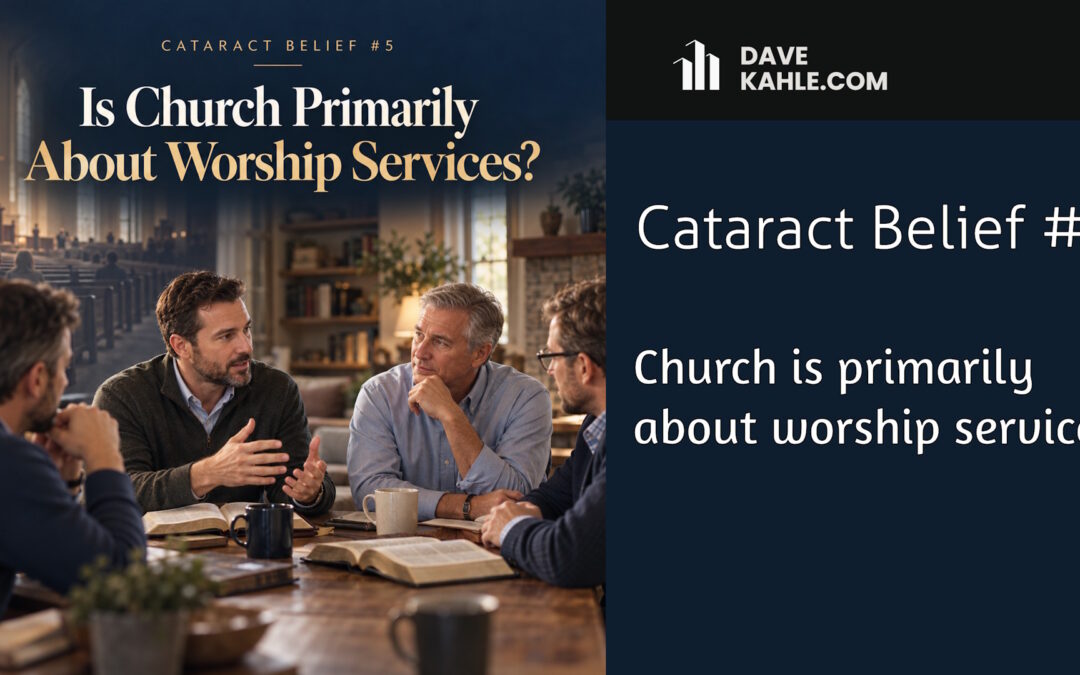
Our
culture has instilled in our minds the idea that church is about worship
services. This idea is so central to the
modern church’s view of “church” that we could not conceive of church as
anything other than this.
Visit
any institutional church and you will always a worship service. In fact, much of the energy and money spend
by the modern church is spent to just so we can have worship services. We need to build a larger sanctuary. Why?
So we can all worship together.
We need to hire a “worship leader.”
Why? So we can have more professional worship services.
Again,
this concept is so deeply instilled that no one can question it without being
viewed as beyond radical, or immensely stupid.
But
maybe they should be questioned. Let’s
again consider this from the viewpoints of the practical consequences and the
biblical perspective.
What
about worship service? Isn’t that the
heart of Christianity? Shouldn’t we be
worshipping together?
Hey, it can be inspiring to be part
of a big group singing together. And a
solid lesson delivered by an experienced professional is always an edifying
thing. Those are good things.
But is it worth it? As long as we
believe that it is, we’ll need “worship leaders,” and large buildings in which
to worship. For a few moments of
emotional lift once a week, we pay professional clergy millions of dollars each
year, and spend billions on huge sanctuaries.
The only problem is that it isn’t
scriptural. “Wait a minute,” you’re
thinking, “doesn’t the Bible command us to have worship services?”
Actually, no. There is no example of a worship service in
the New Testament, and no command to do so.
Not only is the idea of a worship service entirely a man-made concept,
the Bible actually teaches something different.
When we come together as a group, it
is not for the purpose of worshipping God. It is for the purpose of building
one another up. Read I Corinthians 14:26 cited below. This clear, direct
command is routinely ignored and avoided by 99.9 percent of churches, who
prefer their tradition of professional-lead worship services to the interactive
assemblies of the New Testament.
Worship, according to the Bible, is
something else. Paul clearly describes
what God expects from us as worship in Romans 12: 1- 3:
Therefore,
I urge you, brothers and sisters, in view of God’s mercy, to
offer your bodies as a living sacrifice, holy and pleasing to God—this is your true and
proper worship. 2 Do not conform to the pattern of this world, but be transformed by the renewing of your mind.
The worship that God expects is not an entertainment event
run by professionals for an hour once a week. It is a lifestyle of commitment,
obedience and sacrifice for our Lord.
“But,” you’re thinking, “its traditional to have worship
services. We’ve always had them.”
Jesus
had something to say about that in Matthew 15:9:
“They worship me
in vain; their teachings are merely human rules.’”
What
if we didn’t have” corporate worship services?”
What would we do?
We’d
probably meet together somewhere. Maybe
in our homes? As we began to learn
together, maybe we’d discover that Biblical worship is a mind-set, not an event
on the calendar. Maybe we’d go about
our daily lives with an attitude of worship.
Maybe we really would worship in ”spirit and in truth.”
But
if we didn’t have a “corporate worship service,” what would we do when we
gathered as a church?
Interestingly,
the Bible has some ideas. You can find them in the dozens of “one-another’s”
commanded in the New Testament. Here’s
an idea. We could minister to each
other! Our meetings, instead of
revolving around an entertaining worship service, might be small groups
ministering to each other.
Maybe
we’d even follow Paul’s command in I Corinthians 14: 26:
What then shall we say, brothers? When you come together,
everyone has a hymn, or a word of instruction, a revelation, a tongue or an
interpretation. All of these must be done for the strengthening of the church.
The
modern church has drifted so far from the simple plan God has for His people
that it actually siphons resources away from the building of God’s kingdom and
has a devastating spiritual impact on you and your family. The institutional church system, with its
reliance on paid pastors, church buildings, teaching and worship services, has
created a passive, spectator form of Christianity that bleeds the power out of
its adherents.
Supported
by our culture, these devastating practices and beliefs are classic examples of
mankind’s “good,” substituting for God’s best.
The
impact of these practices can have an eternal consequence for you and your
family because they draw your attention to efforts other than the pure simple
Gospel of Christ, and lull you into spiritual apathy.
What
to do about it?
Clearly
you must begin with a great deal of prayer.
You’ll want to bring God into your decision-making process, and you’ll
need His guidance and power to follow through on any plan you create. Patiently and fervently pray for His
guidance.
It
may be that you are led to begin with some small steps. It may be that you find
yourself looking as your home as your initial “church.” You may want to begin Bible studies within
your family, so that you grow less dependent on the professionals. You may want to begin to set aside your
“give” money each week in a fund, and wait on the Lord to show you what to do
with it. You may want to begin to
identify and exercise your spiritual gifts, independent of any congregational
affiliation.
These
are all examples of small steps away from dependence on the institutional church’s
practices.
It
may be that God leads you to seek out a home church, or to start one. You may
be surprised to find that there are resources and support on the Internet as
well as in almost every community.
Regardless
of the steps you take to move away from your dependence on these spiritually
devastating practices, you should be aware that your ideas will be viewed as
alarming and radical by almost everyone with whom you share them. Your pastor will probably tell you that you
are absolutely wrong, your friends will not understand, and others in your
current church will view you as a threat.
The seminaries, denominational officials, and all the other professional
Christians who have a vested interest in the status quo of the institutional
system may ridicule you and be angry at you.
Think
carefully about trying to change the church or convince your pastor of your
point of view. Remember, they have a
vested interest in maintaining the status quo.
In
just the same way that Jesus was a threat to the established religious
institutions of His time, so you will be viewed as a threat by the
institutional establishment. Stay the course; seek out like-minded people with
whom to associate. Deepen your relationship with Christ and the other
Christians in your life. Allow God to lead you.
And
expect the benefits of living under God’s simple practices for His people
instead of mankind’s seemingly improved versions.
What
about you? Where do you stand on this
issue?
Maybe
you are at one end of the spectrum – “Of
course the church is about teaching and worship. Anybody who dares to question that is a
heretic. There is probably something wrong with you.”
Or,
maybe you are at the other end of the spectrum: “Yep. I agree.
I left the institutional church years ago and my family and I are
growing spiritually in a house church fellowship.”
Or,
maybe you are somewhere in the middle: “I never thought of it that way. Let me carefully consider what you said.”
In the last few
decades, the institutional church system has spent 530 Billion dollars, has not
expanded the percentage of Christians by even one percentage point, and has
lost the culture. Isn’t it time thoughtful people asked some questions?
http://www.acalltoarms.co/is-the-institutional-church-really-the-church-2/

Related Resources

