
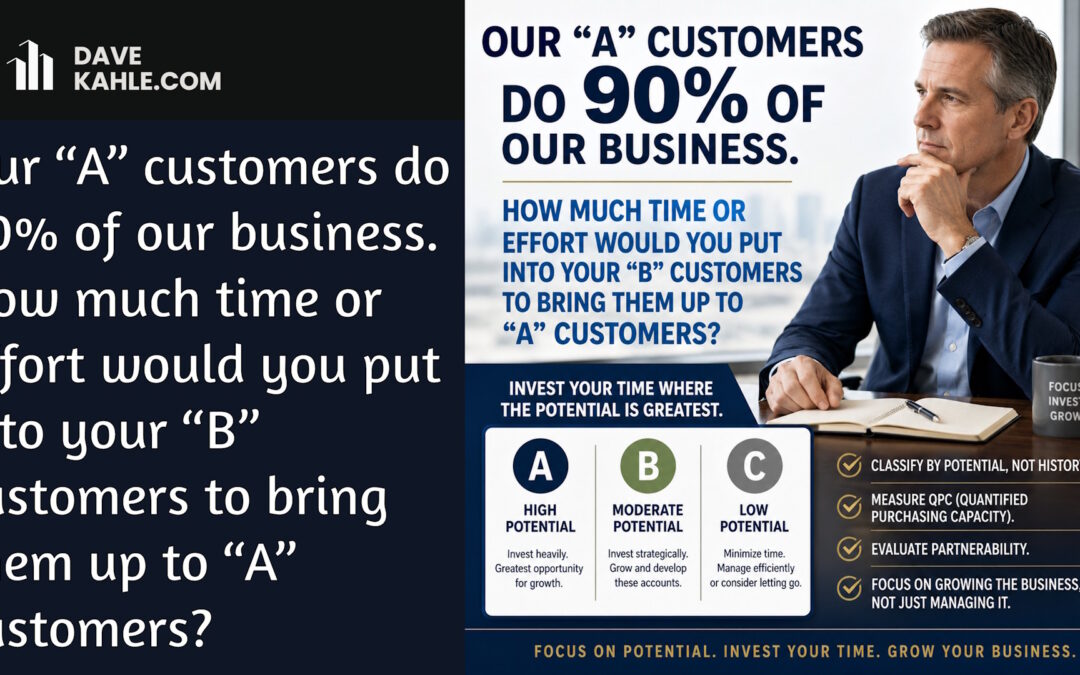
Q. Our “A” customers do 90% of our
business. How much time or effort would
you put into your “B” customers to bring them up to “A” customers?
A.
This is the kind of question I field in almost every one of my
seminars. The answer is a little more
complex than the questioner may have in mind.
First, let’s make sure we’re using
the same language. There are two common
ways of classifying accounts. One way,
which is what the questioner is using, is to classify by the total volume of
sales and/or gross profits. Thus, an A
customer is someone who bought more than a B customer. The other way, which I believe is more
effective, is to classify the customer based on potential. Thus, an A customer has the potential to buy
more than a B customer, regardless of what they have actually purchased.
In the first, the focus is on history
and the past. As soon as a sale is made,
it becomes history – an event which has occurred. Thus to classify accounts by the volume of
business is to look at your customers historically. While there are uses for this system, it’s not
a good way to determine the best investment of a salesperson’s time.
It views the salesperson’s job as
primarily taking care of current business, not necessarily investing in the
growth of future business. Thus, the
more the customer buys, the more time you should spend with them. Followed to its logical conclusion,
eventually the salesperson ceases to be a salesperson, and becomes a mobile
customer service representative – spending all his time taking care of current
business.
I believe salespeople should be sales people. They should focus on growing the business,
not necessarily just taking care of existing business. So, I recommend the second classification
system: Classify your accounts according
to the potential for future business. In
that system, it’s possible that an A account has never bought anything from
you.
In order to do that, you need to
collect some fairly detailed information about each of your accounts. For example, you‘ll need to answer this
question: “If this account bought
everything they could from me over the next 12 months, how much would that be?”
The answer to that question is what I
call QPC (Quantified Purchasing Capacity) and it is the objective measurement
of an account’s potential.
But that is only half of the
equation. You’ll also need to collect
subjective observations about the account, and compile those into a criteria
that I call “Partnerability.” Combined,
those two measurements amply describe the account’s potential and allow you to
rate every account into one of three categories, A, B, or C.
By the way, this whole system is
described in detail in Chapter Five of my book , 11
Secrets of Time Management for Salespeople.
It’s a bedrock discipline of my Kahle Way B2B Selling System, and a part
of almost every seminar I present.
Having established that, let’s go
back to the reader’s question: How
should you invest your time?
If you classify your accounts by
history, then you need to further divide each class into two sub-classes: Growth and Management. Thus, if you have an account in which you
have all the business, it is a “management” account. If, however, there is room for more business,
it is “growth” account.
If you have an A or B account in which
you have all the business, then work to reduce the time and effort you put into
that account. Facilitate relationships
with your customer service people, with your operations and inside people and
try to remove yourself as much as possible from interactions with the account. The selling is done, now it is just a matter
of servicing them to keep them happy.
If you have an A or B account which
has lot of room to grow, then invest heavily, as this will likely be the best
investment of your time.
The issue is not how much they are
currently buying from you, the issue is how much more they could be buying from
you — unless, of course, your job is to be a mobile customer service rep and
not really a salesperson.
Which brings us to the place I
recommend for every salesperson.
Classify your customers according to their potential for future
business. Create three classes: A, B and C.
Spend half of your time with the A’s and the other half of your time
with everyone else.
Making this change in how you view
your customers is one of the single most powerful things you can do. By investing your time in those accounts that
have the most potential, you can reasonably expect to dramatically increase
your business in a few years. Literally
thousands of salespeople have done so.
Good luck.
Related Resources

