
Adapted
from How to Sell Anything to Anyone Anytime by Dave Kahle. Career Press.
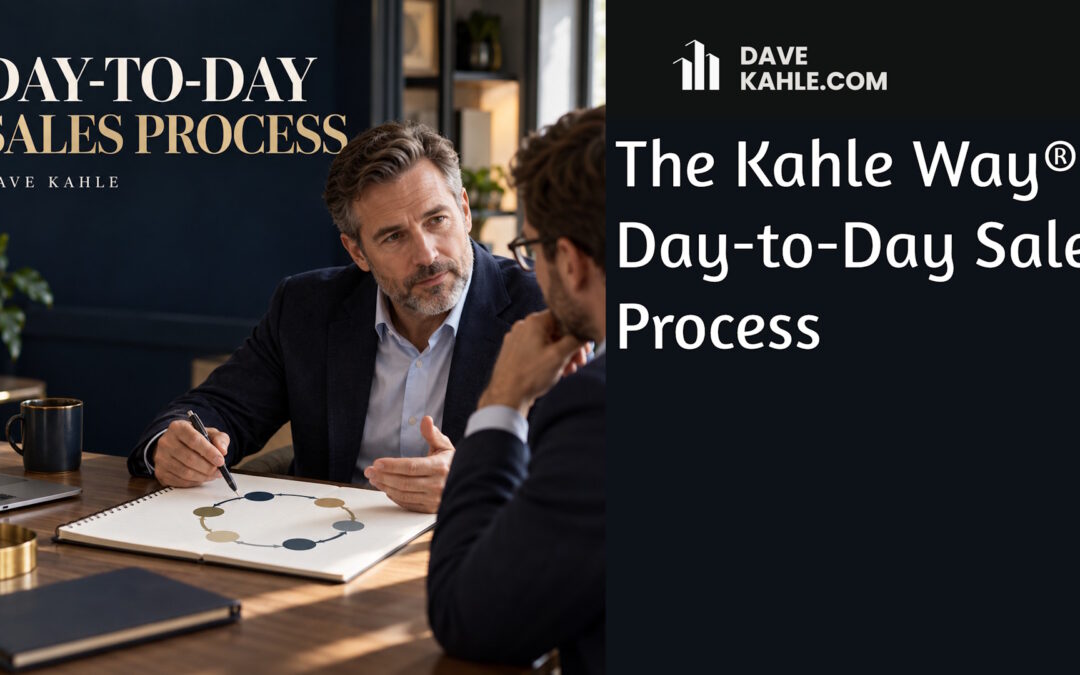
This illustration is from my book, How to Sell Anything to Anyone Anytime.
It provides a useful way to look at what we do as salespeople every
day. Sometimes we can work through
process in a ten-minute phone call, while others may take a year or so to
complete.
Regardless, understanding what we do
provides a structure to help us improve.
We can look at each step in the process and determine how to do it
better.
Step One: Engage with the right people.
“Engage” means to interact in some kind
of communication. It can be
face-to-face, over the phone, via email, or via a website. “Right people” means those people who have a
need or interest in your product, and for whom the timing is right.
If you don’t engage with the right
people, you spend all of your time in the wrong place. Sort of like trying to plant your carrot
seeds on a cement sidewalk. You can do
everything else right, but it won’t matter. Notice, first, that each step
occurs within the framework of the “right people.” In other words, if you do all the right
things, but do them with the wrong people, you’re not even on the diagram. It’s an exercise in futility and a waste of
your time.
Step Two: Make them comfortable with you.
If they are going to believe what you
say, you have to be somewhat credible, and they have to feel at least a bit
comfortable with you. If they aren’t
comfortable with you, they won’t spend much time with you, and the time that
they do spend will be guarded and tentative.
It doesn’t matter if it’s on a website, or in a face-to-face encounter. They may be convinced to do business with you
because of the fundamental attractiveness of your offer, but if they are not
comfortable with you, it will be action taken against the grain. They will be forever uncomfortable and eager
to find a replacement.
On the other hand, if they are
comfortable with you, they won’t mind spending time with you. They’ll be much more open to sharing the
information that is necessary for you to do a good job of crafting a solution. They’ll believe what you have to say. You’ll get the benefit of the doubt, and
they’ll be eager to share future opportunities with you.
Then notice that step two, make them
comfortable with you, is in the center of the diagram, touching every other
step. While it must happen early in the
sales process, it must be continually nurtured throughout the process. At any point in the process, your customer
can grow leery or irritated with you, and that disrupts everything.
Step Three: Find out what they want.
Selling is not manipulating people so
that they take something they don’t want.
It is, instead, finding out what they already want, and appealing to
that interest. The best salespeople
excel at this step in the process.
I believe this step is the heart of
selling – the essence of what sales is all about. I know that flies in the face of the routine
practices of multitudes of salespeople, who believe that all of their focus is
to push their product.
You can proclaim the merits of your
product to willing and unwilling listeners and web page visitors far and wide,
attempting to sway them with the powerful features and advantages that your
product offers over the competition. Or you can focus on the customer, finding
out what motivates him, what issues are important to him, what problems he has,
what objectives he is trying to solve, what he looks for in a vendor, etc. That’s a better way.
Everything that comes before is designed
to get to this understanding. And everything that you do after is based on this
step. It is the fulcrum upon which the
entire sales process pivots.
Step Four: Show them how what you have gives them what
they want.
Proclaiming your product’s features is
the preferred routine of the mediocre salesperson. Personally and individually crafting your
presentation to show the customer how what you have gives him what he wants is
the mindset that, in part, defines the master salespeople.
If what you have doesn’t help them get
what they want, you either have the wrong thing, or you are talking to the
wrong person. See how simple this is?
Step Five: Gain an agreement on the next step.
Closing the sale is by far the most
over-hyped phase of selling. If you have
the right person, and you have uncovered something they want, and you have
shown them how what you have gives them what they want, why wouldn’t they take
the next positive step? It’s
natural. You just need to help them
define what that is and commit to it.
In a simple, direct to the consumer
sale, the next step is typically to buy the product. However, in more complex sales, there can be
a series of appropriate next steps. They
may need to test it, to evaluate it, to submit it to a committee, etc.
Every sales interaction has an assumed
next step. If you call someone for an
appointment, the next step is the appointment.
If you present your solution to a decision-maker, the next step is the
order. In between, there are thousands
of potentially different sales calls, and thousands of potential action steps
that follow the sales call.
The agreement is the ultimate rationale
for the sales call and the aspect that makes it a “sales” call. A sales call is set apart from the rest of
the interactions in this world by the fact that it anticipates an agreement.
Without
an agreement, the process has been a waste of time. It is the ultimate goal of every salesperson,
and of every sales process, and of every sales call.
Step Six: Follow up and leverage the transaction to
other opportunities.
After they buy, you then make sure that
they are satisfied, and you assume that, because they are satisfied, they will
want to do other business with you and will want to let their friends know
about you as well. Sounds simple, and it
is.
This is the step of the sales process
that is most commonly neglected. Most salespeople
are so focused on making the sale they neglect to consider that their real
purpose is to satisfy the customer. And
that extends beyond just the sale itself.
The sales call on the customer, made
after the sale is complete, delivered and implemented by the customer, is one
of the most powerful sales calls available.
In it, the salesperson seeks assurance that the customer is satisfied
and then leverages that affirmation to uncover additional opportunities within
the customer and/or referrals to people in other organizations.
You can do each step better.
It’s one thing to be able to do each
step, and it’s another to be able to do each step better! Just like every other field of human
endeavor, there are the average performers, and there are those who do it
better!
Here’s an example. I love to golf. But I am, at best, an average golfer. I’m not nearly as good as many of the golfers
in my league. I know I can golf better –
after all, many of them are better.
Every year I expect that I will golf a bit better. But, alas, I just don’t have the time and
energy to put into becoming better. So,
while I am an average golfer, I could, if I chose, become better.
So, too, with every one of these
steps in the process. There is adequate
performance, and then there is better performance. But it’s not an either/or kind of situation. There are degrees of better. There’s lots of room between me and Tiger
Woods.
Think of your performance on each
step as being like a dart target. You
know the kind I’m thinking about – it is split into 6 or 8 pie shaped slices,
and has a number of rings, each smaller than the one immediately to the outside
of it. The bull’s eye, in the middle of
the target, has the greatest scoring potential.
When you are playing darts, you throw
your darts at the target, and the closer your dart strikes to the bull’s eye,
the more points you score. If your dart
strikes at the outermost ring, you score just a few points. But you do many times better if you hit the
bull’s eye.
Now, every time you engage in one of
the process steps, it’s like throwing a dart at the target. You can hit the outer ring and score a few points
or hit closer to the bull’s eye and score more. You can do each step of the process, or you
can do each step better. And, like the
ever-smaller rings of the target, there are degrees of better. The bull’s eye is always the vision of
perfection.
As we discuss each step of the process, I’ll show you how
to do it, and then, how to do it better!
***************************************
Question: Where Do You Go to Learn the Best Practices
of Sales Leadership?
Answer:
The Leader’s Track of the Sales Excellence Club
* Weekly content curated specifically
for sales leaders
*
Engage with other like-minded sales leaders in an online community
* Monthly implementation guides to help
you embed the practices into your routines.
This opportunity goes away when we reach
200 members. Don’t miss it.

