
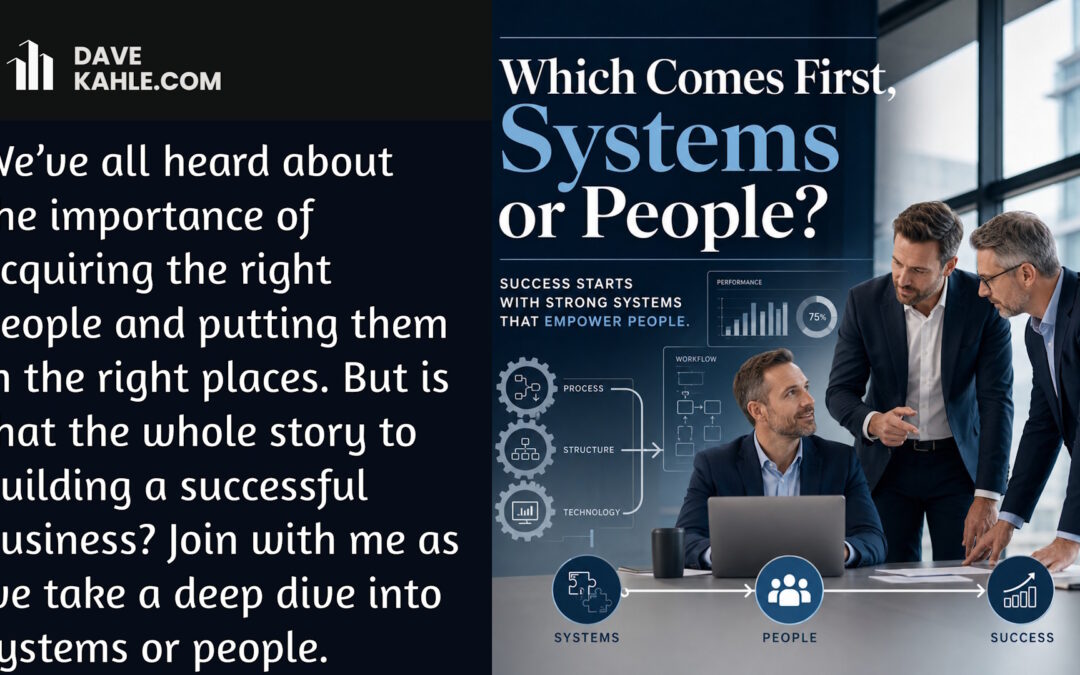
There is a lot of business advice out there recommending that you hire the best people you can find, and delegate substantial responsibility to them. We’ve all heard the metaphor of the bus. Put the right people in the right seats of the bus, and your business will multiply.
It sounds good, but how accurate is it? Over the 35 years that I have been in practice, I have personally and contractually worked with over 500 organizations. I’ve
learned some things. One of them is this: The emphasis on the ‘good people” strategy is way overdone.
Of course we hire the best people we can find, at least in theory. Most likely we settle for whoever rises to the top of the small group of interviewees who have actually applied for the job. In the big picture, they may not be the best person for the job, but they are the best available at the moment.
The problem with the bus metaphor is that it is incomplete. If your business is the bus, you need to attend to a whole lot more than just the people. You can have the best group of people in the world, all arranged perfectly in the seats on the bus, but if the bus is broken down, the tires are flat, the transmission has seized up and the driver is asleep, it is not going to go anywhere.
Every business is composed of two fundamental components: The systems and the people. In the metaphor, the mechanics of the bus represent your business systems. If your systems are faulty, your people will stagnate on the bus and your organization will not be nearly as effective as it could be.
Good systems stimulate people to be more effective. Most people do better understanding that their role is part of something bigger. They perform better when they know exactly what is expected of them, for what they are being measured, how they are doing.
A good system steps into that gap and provides exactly that. Good systems have precise job descriptions with a background of how this particular job fits into the big picture. Good systems regularly measure the important behaviors and provide that information to the people concerned. And good systems provide regular feedback. Under those conditions, everyone does better.
But there is more. Good systems allow you to make better hiring decisions. Here’s how it works. When your job description is vague and general, you need a higher-level person to make it work. On the other hand, when your job description is tight and specific because it fits into a system, you can hire people who are not at the top of the spectrum. The pool of potential employees is larger when you have tightly described each job.
Think of McDonalds. They don’t hire a group of executives put them in a store and tell them, “You guys figure it out.” Instead, they have precise, well-designed systems and even entry level teenagers can be productive in them. There are a whole lot more entry level teenagers available than there are C-Suite level executives.
Here’s another major advantage of focusing on systems. You can make changes in the system, and it will have a disproportionally large impact on the business and be far less costly than working with the people. As a sales consultant and sales trainer, I work with both systems and people. And, while it is fulfilling to help a salesperson move from a “7” to a “9”, it is far more effective to make some tweaks in the system and see everyone become more productive as a result. When you change the system, you change the productivity of everyone who works within that system. I have made a huge impact on an organization by tweaking its systems without actually meeting the people.
While there are lots of pieces to a system, here’s an example: the sales compensation plan. Change the plan, and reward salespeople for doing exactly what you want them to do, and, amazingly, they do it! We can make dramatic improvements in a sales system and impact on the top line, by refining the compensation plan, and never meeting the salespeople. This part of the system directs and focuses the salespeople, and, as a result, they perform better than they did with a faulty system.
So, it is with other elements and other systems. The quickest, most effective changes in an organization come from refining the systems.
Not that you can ignore the people. As a sales trainer, I am always gratified to see a light go on in someone’s head and the resulting change in behavior stimulates radical increases in productivity.
But, first the systems, and then the people.

Related Resources

