
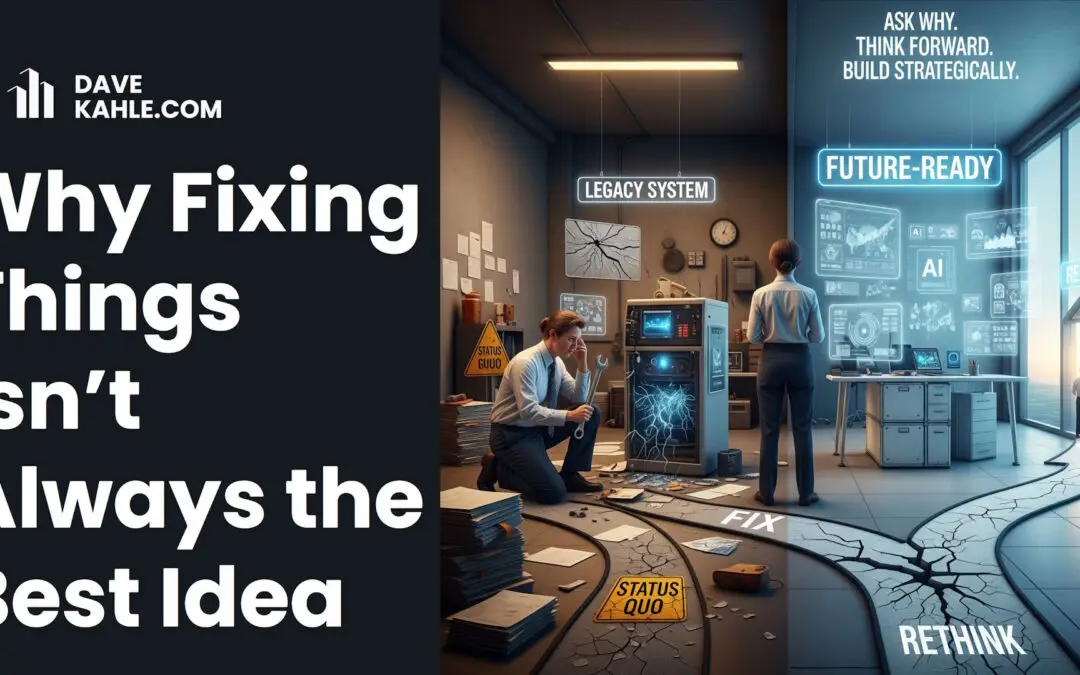
Some time ago, one of my clients
challenged me to record the 20 most important lessons I’ve learned in my 30
years of consulting experience. After a great deal of reflection, I eventually
came up with 25. This is one. Fixing
things isn’t always the best idea. In our rapidly changing world, instead of
restoring the status quo, we need to build for the future.
Here’s a couple of examples. Let’s say you’ve determined that a piece of
software is becoming unreliable. You
could get the vendor to upgrade it, or you could look at the applications for
which you use the software, and search for something that will serve you for
the next few years. Instead of fixing
what you have and returning everything to the status quo, you focus on gearing
up for the future.
Or, one of your salespeople has left for
greener pastures. You could, in a knee jerk reaction, begin to search for
someone to replace him/her, or you could take a deep dive into the dynamics of
the customers, the territory, your future products, and determine that maybe a
replacement outside salesperson is not the necessarily the best move. Instead you invest in some additional
software, and expand the role of one of your inside salespeople.
In both cases, while you were tempted to
just fix the situation and return everything to the status quo, instead you
took advantage of the need for change by looking to the future and putting in
place a solution that is designed for the future, not the past.
In both cases, the decisions to buy the
old software or to hire the departed salesperson were made in an earlier time,
by different people, for a set of circumstances that have long disappeared.
Over my 30-year career, I’ve worked with
over 500 sales organizations. In all of that, I’ve concluded that very few
policies, procedures or people have been strategically put in place to deal
effectively with the future. Most of those
things are vestiges of times past, put in place by a previous generation of
people for a long-gone situation.
When we are faced with a need to take
urgent action because something is broken, our knee jerk reaction is often to
replace the offending decision with another of the same type. In so doing, we hinder the company’s
advancement and miss an opportunity to move forward.
Because the fix-it mentality is so ingrained
in most of our psyches, we need to face the next major maintenance with a
mindful discipline. It requires a change in mind-set. Suppose we look at
everything that needed serious maintenance as an opportunity to put in place a
strategically forward-looking new solution?
Here’s a simple three -step format that
will help capture the future solutions.
1. Articulate the issue as clearly and
specifically as you can. For example: “We’ve just lost one of our outside
salespeople. The territory is now
open. We need to fill the territory.”
2.
Ask “Why?” two or three times.
So, “Why?”
Answer: “We
can’t have an open territory for long.”
“OK, Why?”
Answer: “We need to continue to serve our customers
and meet our sales goals.”
“So, what you really want is a way to
serve your current customers, and make sure that your key product lines are
presented appropriately?”
3.
At this point, you may have uncovered the real question, so you edit it
a bit and write it down: “Is there a way to serve our current
customers and present our key products
that that is less expensive, or more effective than taking the risk on another
outside salesperson?”
While coming to the actual solution may
take a bit more time, you have identified the forward-looking action. The way is now clear for a wider range of
creative solutions. You could, for
example, create a web portal for each of your current customers, on which you
maintained their pricing, as well as the status of every order and receivable.
That might even take better care of them than a salesperson who called in
person every few weeks. Maybe you could schedule
video lunch-and-learns in which you have product experts present the new
products. You could set that entire
system up in a month or so for far less than the cost of a few months of a replacement
salesperson. Now, I’m not proposing that
is the solution, only that it is an example of the kind of creative solution
that can follow your question.
In this little 10-minute thinking
exercise, you have vaulted from a knee-jerk reaction to a strategic focus on
the future. This will work on almost
every ‘fix-it” type of situation that is big enough and impactful enough to warrant
a little bit of out-of-the-box thinking.
In an era where AI threatens to replace
millions of white-collar workers, those who survive and prosper will learn to
think better than their colleagues. This
is an example of one of the dozens of applications in our Mind Software series
of training programs designed to help you think better. Learn more here.
To access all of Dave’s Christian Business Insights content FREE – posts, articles, podcasts, and videos https://davekahle.substack.com/s/christian-business-insights
If you’re ready to:
– Sharpen your skills
– Increase your sales and income
– And build a career you can be proud of
…then I invite you to join me as a charter member of the Kahle Way B2B Sales Excellence Club – Christian salesperson track.
The Kahle Way ® Sales Excellence Club is a practical, ongoing system to help serious B2B salespeople consistently grow their sales, confidence, and career while having an impact on the Kingdom.
Specialty tracks for Christian Salespeople and Sales Leaders.
Related Resources
https://davekahle.pink-account.com/sales-leaders-q-a-motivating-the-sales-force/
https://davekahle.pink-account.com/business-model-leadership-character/
https://davekahle.pink-account.com/do-you-want-to-become-a-sales-manager/
Making an impact: https://www.davekahle.com/impact-through-business/
Build Menta-Morphosis into your routines; https://www.davekahle.com/menta-morphosis-intro/

