

Engage with the right people
Excerpted from How to Sell Anything to Anyone Anytimes, by Dave Kahle. Career Press
As we work through the sales process, you’ll find me saying, in each chapter, that this step is critical. This one, however, is really critical. You may have the greatest product and the best price; you may be the most charismatic human being ever, with an extraordinary empathy for your customer, a persuasive presentation, and incredible closing skills. However, if you spend all your time with prospects who have no need for your product, no interest in it, no time to devote to you, and no money to spend, all of your superlative resources will be wasted.
On the other hand, if you have less than average sales skills and a mediocre product at a higher than market price, but you stumble across a prospect who desperately needs what you have, urgently wants to buy it, and has the money to spend, you are much more likely to make the sale and satisfy the customer.
Engaging the right people trumps every other piece of the sales process. If you can consistently do this well, you don’t need to be exceptional at anything else. Your sales skills can be just adequate, but you’ll be successful on the basis of your excellent execution of this key process step.
Of course, it’s not that easily done. Many talented sales people and valuable businesses have suffered through mediocre results because of their inability to do this well. It is, unfortunately, almost impossible to consistently and exclusively engage with the right people. A great deal of sales time is invested in just getting there. “Getting to the decision-maker” is an elusive but universal charge to every sales person.
This first and fundamental step in the process is composed of two sub-tasks that combine to make up this piece. As you’ll see, for every piece of the puzzle, it is not enough that you do it, you must do it well!
Let’s look at the two primary sub-tasks that combine in this crucial first step.
- Decide who are the right people.
- Find the best way to engage with them.
In this article, we’ll deal with the first of these two sub-tasks, and in the next chapter, the second sub-task.
Decide who the right people are.
This is absolutely crucial work. The better you do this, the more likely you are to be successful.
Our natural tendency is to define the “right people” as broadly as possible, so as to include as many people as possible. When we take the opposite approach, however, we usually discover it is a more powerful selling decision.
Here’s an example. One of my clients makes replacement parts for foreign cars. As long as he defined his market – the right people — as “owners of older foreign cars,” he muddled along, unable to clearly identify the individuals within that general category, unable to create any visibility or credibility, and unable to distinguish himself from the multitudes of competitors.
Then he decided to narrow his focus. After a great deal of thought, he arrived at a much more clearly defined understanding of the “right people” for him. “Owners of two models produced by X manufacturer for the time period 1930 through 1980.”
Armed with this narrow and precise definition of his market, he was able to create and deliver, first a catalogue, and then, a website that appealed to those people. He was able to find the media that appealed to them, and locate the shows and events they attended.
Then, because of the narrowness of the niche, he was able to dominate it, allowing him gross profits in the triple digits. Unless you are a Pepsi Cola, Microsoft or a Google, or someone who has hundreds of millions of dollars to spend on creating a marketing system that sells to everyone, you’ll find that the more precise and specific you are in your definition, the easier it is to engage with those people.
That’s our first rule: Precision and clarity are better than general and vague.
The decisions you make about the identity of “right people” are crucial to your success. Make the wrong decisions, and there is no overcoming it. Here’s a website example. A consultant friend was engaged in trying to identify why the site wasn’t working, and I was asked to give my opinion. The site was extremely well done, and clearly a lot of money had been spent in the technical details. From a technical point of view, the site was possibly the best I’d ever seen.
The problem wasn’t, however, in the mechanics of the site. The site was designed to offer a product in which a great portion of the price of that product was dedicated to be donated to a series of causes. The buyer could stipulate which cause he wanted his money to go.
Here was the problem: There was no clear definition of who were the right people. For example, if you were someone who cultured a taste for that product, you wouldn’t be interested in buying from this website, because there were far more extensive selections and far higher grade products readily available. If you were of the class of people who wanted to donate to some of the causes, you could do that directly, and get the tax write off for it. So, who are the “right people?” People who didn’t have much of a pallet for the product, didn’t have much money to support the causes of their choice, and didn’t mind paying considerably more for the product. Let’s see. How many of those people are there?
The owner was guilty of the most common mistake made by start up businesses. The entrepreneurs who start the business have an idea with which they become enamored. They are convinced of the power and appeal of that idea and put lots of time and effort into bringing it into fruition. However, they don’t have a market for it. The world doesn’t think nearly as much of the idea as the entrepreneur thinks of it. His great idea came to nothing because there weren’t enough of the right people out there.
In this case, it was a website and a business that probably absorbed hundreds of thousands of dollars. But it could just as well be the free lance professional trying to find someone to hire him, or the coffee shop that located in the wrong place.
If you are an entrepreneur in a start-up mode, this is the most fundamental decision you can make. If you are a B2B sales person, and you have never defined the precise group of “right people,” you’ll find yourself wasting hours and hours calling on people who just waste your time. Regardless of your unique circumstances, this decision trumps all the others.
All the decisions that follow this one are dependent on it. If you are an entrepreneur starting a business, your definition of who the right people are will dictate the kind of business you start!
For example, if you want to start a web-based business, but your right people are local and not very computer literate, you are probably destined for failure. If you are a professional hoping to free lance, and the people you define as the right people are a group of about 100 individuals within a 100 mile radius of your location, you would be stupid to invest in a web site
You see, everything that follows – all the decisions you make as to how to appeal to them, what sort of offer is best, what medium is most effective, etc. are all dependent upon this decision.
Here’s an example. One of my clients represented a service that was particularly suited to trial lawyers. The decision to define the right people as trial lawyers within a certain geographical area then shaped and influenced the best way to engage with them, the kind of literature to create, the best words to use to approach them, etc. He discovered that one of his most effective prospecting strategies was to frequent the pubs where the trial lawyers often congregated at the end of the work day.
It is one thing if your right people are professional, quite another if they are farmers. It is one thing if they are local, quite another if they are spread out all over the country. It is one thing if you can look them up in the phone book, quite another if they are protected by layers of gate-keepers.
Here’s the point. All the decisions you make as to how to sell are dependent on the decision as to whom you sell.
How to do this well
Here is the question, the answer to which will do more to assure your success than any other single question: “Who is most likely to need/want what I have to offer?”
I know this sounds basic, but much of my career has been spent working with sales people and sales organizations who have never really asked and answered that question.
In order to come to a good decision, let’s break that down into a number of smaller questions.
Who needs or wants what you have?
Who can pay for it?
Are there enough of them to make it worth my time?
Can I identify them?
How can I gain access to them?
Who needs or wants what you have?
That’s the fundamental question. Describe the people or organizations that you think would need or want what you have. Remember, the more precisely you can describe them, the easier it is to sell to them.
Who can pay for it?
I hate to be so coarse, but the ultimate purpose of your sales effort is to get money. If the people who want it can’t pay for it, you must adjust your sales strategy. For example, the world is full of college students who would love to have a new Corvette. However, only a small percentage of them can pay for it. So, if you are selling Corvettes, “college students” are not the right people. You’d be better off defining your right people as “50-ish, successful professional and business people.” That’s a more lucrative definition.
Are there enough of them to make it worth my time?
If there are only a handful of them, it’s probably not a good business idea. I’m sure some of you were mentally arguing with my thinking in the above paragraph. “Wait a minute,” you thought, “there are some college students who could pay for a new Corvette.” Probably so. But not enough of them to make it worth your time.
Think of the great website effort described above. How many pallet-less, penniless, gullible people are there? Not enough to make it worth your time. The answer to this question provides you guidance in how extensive your sales efforts can be. For example, if you’re a free lancer looking for people to hire you to write grants, maybe 50 or so would be sufficient. If you are considering selling $5.00 home-made desserts over the internet, there had better be a whole lot more than 50 “right people”. If there are 5 million “right people” you are going to need an entirely different sales approach than if there are 50 “right people”.
How easily can I identify them?
Before you can engage with them, you have to identify who they are. The answer to this question requires you to move beyond the description of a group, say “50ish, successful business and professional people experiencing a mid-life crises,” to assessing the likelihood of you actually being able to populate that list with the names and contact information for the individuals within that group.
Do you know of a way to ferret out the individual organizations and/or people who populate your list? How accurate will your list be?
How can I gain access to them?
Remember, this is about engaging with the right people. First we have to identify the right people and then we have to engage with them. If we know that we are not ever going to be able to engage with them, then they aren’t the right people. The process is a bit circular but effective, nonetheless.
Your definition of right people may be, for example, “former presidents of the USA.” Unless you are really well-connected, or have the time, money and energy to get really well-connected, you are just not going to ever gain access to them.
The Process
You can answer these questions broadly and generally, or you can answer them narrowly and specifically. Remember, narrow and focused are better than broad and vague.
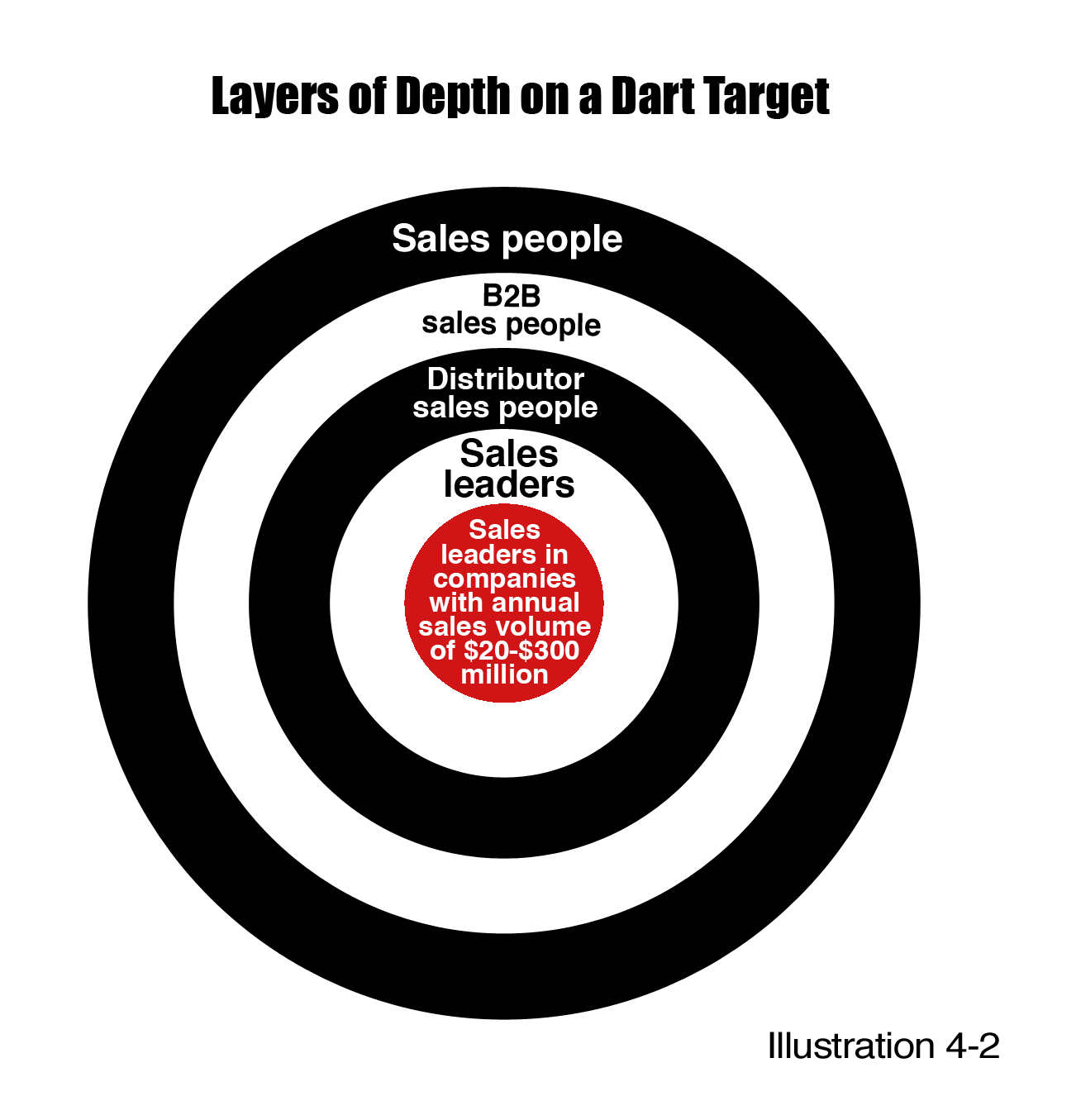
But, you may have to begin with broad and vague and continually sharpen your focus by narrowing your answers. You recall the diagram of the dart target from Chapter Three.
In a dart target, the closer you get to the bull’s eye in the center, the more points you score. Each ring of the target, starting at the outer ring and working in, contains more and more potential for scoring.
So it is with defining your right people. There are rings and layers of ways to define them.
Let me illustrate with my sales training practice as an example. I have great material for helping sales people become better at selling. So, my larger universe of right people is the world of sales people. Think of them as the outer-most ring.
But not every sales person is equal. We really do better with B2B sales people than with others. So, while we have resources for every sales person, we specialize in sales people who operate within the B2B world. Let’s label the next ring with that designation.
Ah, but we can narrow down even further. Within the world of B2B sales people, I have a special affinity for wholesale distributors. So, let’s draw another circle inside and label it distributor sales people.
Now, while sales people are a market for us, and are the ultimate beneficiaries of what we do, they don’t spend nearly as much money as their bosses spend. Thus, while a sales person may spend $20 to buy a book from our website, their boss has the ability to spend $20,000 to hire us to train all of his 20 sales people. So, let’s draw another circle inside and label it sales leaders, understanding it encompasses both sales managers and sales executives.
But we are not done yet. A little experience leads us to the conclusion that not all sales leaders are equal. For example, while we have products and services that almost any principal can utilize, some have businesses that are too small to be lucrative targets for us. On the other hand, some of the folks in our potential market work in businesses that are too large – they have developed internal sales training programs, and have only limited interest in an outside source. So, let’s apply that understanding to our target, and we define the bull’s eye as sales leaders in wholesale distribution businesses that do between $20 and $300 million and annual sales.
We could keep going with this exercise in continually narrowing our focus until we reach a list of individual people, or, eventually, even one individual. And, in some selling situations, that’s a good idea. But for now, let’s stop there. We’ve defined several layers of “right people” starting with “sales people” on the outer ring and progressively toward “sales leaders in distribution businesses of between $20 – 300 million in annual sales.”
As you can see, in defining our right people, there are layers of suitability.

Let’s now apply that concept to a number of possible scenarios. If you are in the initial stages of planning for a new business, you have a great opportunity to create a clear definition and build your business on that foundation. But, you can do this exercise, and you should, every year that you are in business. Things change. You gain more capabilities. The market changes. We teach B2B sales people a process for determining, annually, the highest potential people within their sales territories. (See Chapter Four of my book, 10 Secrets of Time Management for Salespeople)
So you are starting a coffee shop, and you have your eye on an empty spot at the strip mall down the street. When you start asking the question, “Who wants/needs what you have?” the first answer is: “People who like coffee.” That’s the outer ring.
OK, but how can we filter through the world at large, and identify those who like coffee? Let’s first narrow it by geography. In all likelihood, people are not going to drive miles to buy your coffee, so you narrow it down by saying: “People who like coffee and live within a one mile radius of my shop.” That’s a more precise definition, and fills the next ring.
But, the strip mall is on a major thoroughfare, and just down the street is a large office complex with a lot of office workers. Let’s account for them – “People who like coffee and live within a one mile radius of the shop, or who regularly drive by.” That’s the next ring towards the center.
Now we are stuck. So, let’s think about ruling people out. Who would not be a possible candidate? I know, you are thinking, “Well, anyone could like coffee.” But some people are less likely than others. For example, people under the age of 16 or so are probably not likely prospects. Nor are people over 70 years old. Since you have a “luxury item”, it probably won’t routinely be on the to-do list for parents of large families.
Let’s incorporate all of that into our statement of who are our “right people: “People who like coffee, are between the ages of 17 and 70, are not parents of large families, and live within a one mile radius of my shop or regularly drive by it.”
We’re getting closer to a precise definition of who the right people are for you. That may be as far as we can take it. In this case, that may be the bull’s eye.
Let’s apply the same process and principles to another scenario. You are an unemployed professional who has decided to establish a free lance practice. You were employed as a design consultant in a private consulting firm. You have some expertise in writing grant applications. So, you decide to free lance as a grant application writer.
Who needs your service? Obviously, “non-profit organizations looking for money.” That’s the outer ring.
But not all of them. Again, some of the larger organizations probably have internal staff to do that. You want organizations that are too small to have a full time dedicated staff person do it, but not so small that they can’t pay for the service.
Let’s say that you use those guidelines to narrow down your definition to this: “Non-profit organizations with annual budgets between $200,000 and $5 Million.” That’s the next ring.
But, organizations don’t make decisions, people do. So, let’s narrow it down even more: “Executive directors of non-profit organizations with annual budgets between $200,000 and $5 Million.” That’s the next ring.
Let’s now take geography into mind and add another, deeper layer:
“Whose office is within a 50 mile radius of me.”
Your quest to precisely define the set of right people could continue on for several more layers. You could, for example, narrow it down by type of non-profit, or, to add some urgency, those who just had their government grant money reduced.
You get the idea. This process and set of principles, applied to any selling situation, any where, with any medium, will, more than any other single decision, determine the relative success of that selling effort.
And, its application is far more extensive than just at the beginning of a new venture. For existing businesses, the issue is more likely one of degree than initial definition. In other words, you already have customers. The issue is what types of customers are more right than others?
For example, I’ll frequently work with a group of sales people who spend much of their time calling on the wrong people – sometimes for years. They invest their selling time in those customers with whom they get along and for whom they feel some affinity, and who can be counted on to see and interact with them. Often, those customers are on the outer rings of their target. – the C and D customers. They can buy, but they are not as lucrative as those closer to the bull’s eye — the A and B customers.
What’s wrong with that, you’re wondering? It’s the wrong set of criteria. They should be defining the right people as those who have greater potential and philosophies and values that compliment their company’s philosophies and values. Since they never really thought it through, they wallow in mediocre performance, sometimes for their entire careers, hindered by the lack of a clear, precise definition of who really are the right people.
As they spend more and more of their time with the customers closer to the bull’s eye, and less time with those on the outer fringes, they become increasingly more effective.
If you have an existing sales effort, then the questions you should ask and answer have a slightly different wording to them. The basic question is this:
“With which customers is my time most effectively invested?”
Your task is to define the bull’s eye, and then to invest your sales resources as close to the bull’s eye as possible. In order to do that, you ought to examine your prospect and customer list and ask:
Who most needs or wants what I have? (How big is the opportunity?)
Who is most able to pay for it? (Who is financially solvent?)
Who is most compatible with my company and me?
Methodically going through this process annually will keep you focused on the highest potential customers and, more than anything else, positively impact your sales success.
Find someone else to help you
This is one of those tasks where two heads are always better than one. Because the answers you come up with are so crucial to your success, you want to make sure that the answers are the best and most accurate they can be.
That is particularly true for this exercise. You are generally too close to the situation to see it clearly. Your vision will be clouded by your emotional attachment to your idea. So, bring in someone else to help you. If you are an individual starting a business or a free lance professional, that means bring in someone with successful sales and/or business experience who does not have a vested interest in the idea and have him/her review your work and challenge your answers.
If you are an established sales person or sales executive, that means bringing in a consultant or someone credible from o eyes to yo ur answers.
The answers are too critical to trust only your own responses.
************************************************************************************
If you’re ready to:
– Sharpen your skills
– Strengthen your pipeline
– Increase your sales and income
– And build a career you can be proud of
…then I invite you to join me as a charter member of the Kahle Way B2B Sales Excellence Club.
The Kahle Way ® Sales Excellence Club is a practical, ongoing system to help serious B2B salespeople consistently grow their sales, confidence, and career.
Specialty tracks for B2B salespeople, Distributor Salespeople, Christian Salespeople and Sales Leaders.

