
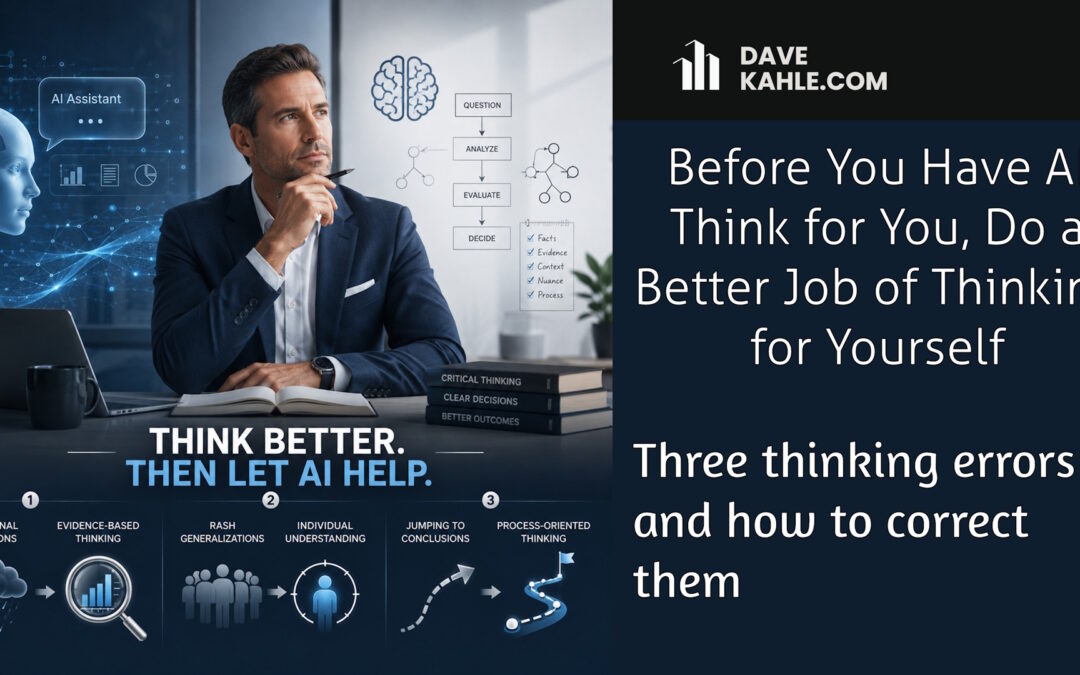
Three thinking errors and how to correct them
While using AI to think for us is easy and tempting, the consequences can be staggering. One of the very real consequences of over dependence on AI is this:
We lose our ability to think clearly.(1)
Before we allow AI to denigrate our thinking abilities, let’s sharpen our own thinking skills.
Here are three errors we often make, and corresponding solutions:
1. Emotional reactions
We react based on how we feel – the emotion of the moment – rather than on the basis of evidence.
This is fine for the plethora of trivial decisions we make every day.
So, for example, “Should I go to McDonald’s or Burger King?” So, for example, the last time you went to McDonald’s you spilled your drink in your car. So, you have negative feelings about McDoald’s. Therefore, you choose Burger King. That’s a decision based on emotion that has nothing to do with the evidence. But, it’s a trivial decision, so it doesn’t matter.
Spend five minutes on social media and you’ll see emotional reactions make up the overwhelming majority of posts. That’s OK because it’s trivial and won’t matter to anyone other than those who also are emotionally involved.
The real danger lies when we use emotional reactions to deal with weighty decisions and thinking challenges. Then, we often make decisions that bring
difficult consequences because we reacted on the basis of how we felt, rather
than what we thought.
When you find yourself (or someone you are talking with) making an emotional response to a weighty challenge, ask “What evidence do I (you) have for this?” This kicks the brain into gear, encouraging the person to think about something outside of his/her feelings, and prompts a more thoughtful response.
2. Rash Generalizations
In this flaw, we create a category — i.e., black, white, teenager, retiree, soccer mom, red neck, etc. Over our lifetime we have slowly compiled a list of common attributes we attribute to that category. So, we could think “teenagers make stupid
mistakes and are often malicious and uncaring of other people’s property.”
Then, instead of considering the individual circumstances, we place the person in the category and draw up our list of attributes. So, for example, when we have an encounter with a young person, we place them in the category (teenagers) and then generalize our judgement of them based on what we think of the category. We don’t deal with the person as a person, we deal with them as a member of a pre-ordained category.
While my example refers to people, we can make rash generalizations about things, events, ideas, etc.
Once again, this is easy because it requires very little thinking. But, like all the thinking errors, it presents us with a conclusion that is erroneous and doesn’t take the individual circumstances into account.
The cure is similar: Ask “How does this individual differ from the mass of people in this category?” This forces our mind to consider the individual aspects of the person or situation in question and moves us from the general to the specific.
3. Jumping to conclusions.
This often occurs in business circles when we see a problem or a project, and we jump directly to the solution, rather than the process to arrive at the solution. We put the solution before the process.
In my practice, I often see this in the project of creating a revised sales force compensation plan. I often field ‘solutions” from the executives involved who say, “We should do this…,” or “I think we should do that.”
They leap from the problem to the solution. These hasty solutions often miss the mark, leave important issues unaddressed and generate unexpected consequences.
Instead of asking for a solution, a better approach would be to ask, “How do we get to a solution?” The answer is probably going to be a process that incorporates more information than one person’s opinion.
These simple interventions require asking a good question that will direct a person’s thinking down much more productive corridors. With just a little
bit of effort, we can think better.
1) The Impact of Generative AI on Critical
Thinking: Self-Reported Reductions in Cognitive Effort and Confidence Effects
from a Survey of Knowledge Workers
- Hao-Ping (Hank) Lee, Advait
Sarkar, Lev
Tankelevitch, Ian Drosos, Sean
Rintel, Richard
Banks, Nicholas
Wilson
CHI 2025 | April
2025
********************************************************************************************
15 minutes a week and .63 cents a day
That’s your investment to develop your skills, meet your biggest challenges and become a master of your profession.
Introducing the Kahle Way B2B Sales Excellence Club
You are invited to be a member of the club.
You have never experienced anything like the Sales Excellence Club. The Club presents a system to help you grow in confidence, competence, and the recognition that comes with consistently strong performance.
Bite size pieces, delivered weekly, sharing the best of 30 years experience helping B2B salespeople excel.
If you think you can sell better, but aren’t sure exactly how to go about it, than check out the Sales Excellence Club. Membership is limited to the first 200 applicants.
Related Resources

